

Capital Reserve Planning for Toronto Commercial Roofs: How REIT and Property Managers Budget for 2026–2030 Replacements
Toronto property managers: how to budget 2026-2030 commercial roof replacements with reserve studies, remaining useful-life and capex escalation.
- Jun 29
This one is for the person building next year's reserve schedule, not the person deciding whether to reroof. If a replacement is coming somewhere in the next five years and you need a defensible number to put in front of ownership or a board, keep reading.
Here is where most reserve models go wrong: they treat the roof as a single line that "ages out" on a fixed date, then fund it on a flat schedule that ignores how the roof is actually holding up. That is how buildings end up either over-funding a reserve that sits idle, or scrambling to reroof in a February emergency with nothing set aside. We have been putting membranes on GTA buildings since 1976, and we have watched the budgeting side go sideways about as often as the roofing side.
The Short Answer
Capital reserve planning for a commercial roof means funding its eventual replacement gradually, based on remaining useful life and escalated replacement cost, so the money is in place before the membrane fails. For a Toronto building it is four steps: establish the membrane's real remaining life from its condition, price a replacement in today's dollars, escalate that cost to your replacement year, and divide by the years remaining, minus what is already saved. Then update the number every three to five years with a condition-based reserve study. Age alone is a bad predictor in this climate, so the study, not the install date, drives the budget.
What "Capital Reserve Planning" Means When the Asset Is a Roof
A capital reserve is money set aside over time to fund the major asset renewals a building will eventually need: the roof, the parking structure, the HVAC plant, the elevators. It sits apart from the operating budget that covers year-to-year running costs. Clearing a blocked drain comes out of operating. Tearing off 40,000 square feet of failed membrane comes out of the reserve.
On most GTA commercial and industrial buildings, the roof is the single largest line in that reserve schedule, or close to it. A replacement on a mid-sized warehouse runs into six figures, and unlike a boiler you can limp along for a season, a failed roof damages everything under it. That mix of size and downside risk is why the roof deserves its own worked-out number, not a placeholder copied forward from three years ago.
Reserve study vs. the repair budget
Keep these on separate ledgers. A documented preventive-maintenance program is an operating cost that extends the roof's life and pushes the replacement date further out. The replacement itself is a capital event you fund in advance. When property managers blur the two, one of two things happens: maintenance gets starved because it is competing with a capital line, or the reserve gets raided for repairs and comes up short when the real bill lands. The upside is that a roof, unlike most building systems, gives you years of warning if you are paying attention. The reserve plan is how you convert that warning into cash on hand.
Step 1 — Base the Plan on Remaining Useful Life, Not Age
The most common reserve-planning mistake we see is funding to a fixed replacement year picked off the install date. A membrane installed in 2010 does not politely fail on schedule in 2030. In the GTA it might be done by 2027 if it ponds water and gets hammered by freeze-thaw, or still be serviceable in 2033 if it was well built and maintained.
Canonical service-life ranges for GTA commercial membranes
As planning anchors for the Toronto climate, budget around these service lives:
- TPO: 15–20 years
- EPDM: 20–25 years
- SBS modified bitumen (2-ply): 20–25 years
- Built-up roof (BUR): 18–22 years
Plan toward the lower end of each range, not the middle. Freeze-thaw cycling, snow load, and ponding water all pull real-world life down, and the ranges above already assume a competent installation. A thin-mil membrane installed over compromised insulation will not reach them.
Condition beats the calendar
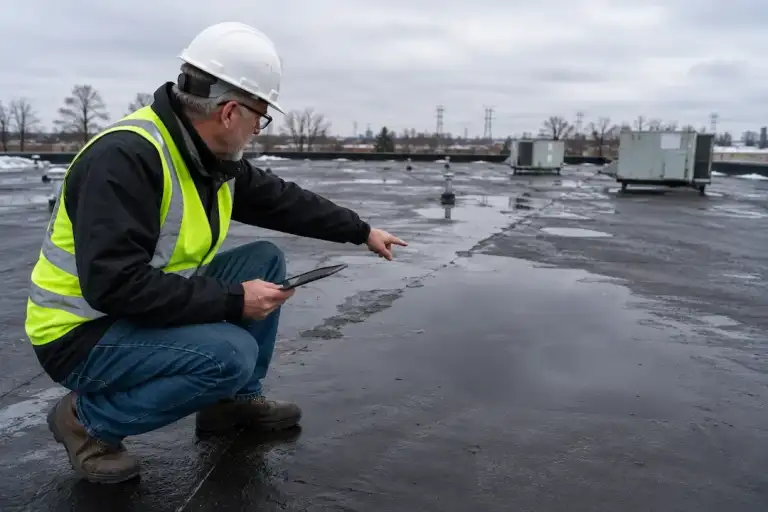
The only honest way to set a remaining-life number is to look at the roof. Twice-yearly seasonal roof inspections catch the early warning signs: seam separation, blistering, flashing failures, ponding that will not drain. For what you cannot see from the surface, an infrared moisture survey maps where water has already reached the insulation, which is usually the difference between "five more years with maintenance" and "budget the replacement now." Feed that into the reserve study and the replacement year stops being a guess.
Step 2 — Price the Replacement in Today's Dollars, Then Escalate
Once you have a replacement window, put a real number on it. For a Toronto commercial flat roof in 2026, plan on roughly $12 to $22 per square foot installed for a full tear-off and re-roof, with the spread driven by membrane, insulation, access, and drainage. By system, the planning ranges land around $12–$18 for TPO, $11–$16 for EPDM, $14–$22 for a 2-ply SBS assembly, and $13–$20 for BUR. Treat these as budgeting numbers, not quotes. Every building prices differently once the crew is on the roof.
Then escalate. Roofing material and labour costs have not been sitting still, and a number that is right in 2026 will be low by the time you spend it. For planning, apply a conservative 4–6% per year out to your replacement year. A small annual escalation is far easier to defend to a board than a reserve that lands $150,000 short because the plan assumed flat pricing.
A worked example
Take a 40,000 sq ft SBS roof installed in 2010. A 20–25 year service life puts the realistic window around 2030–2033; conservatively, you plan for 2030. At today's SBS pricing, call it about $17 per square foot loaded, so roughly $680,000 in 2026 dollars. Escalate five years at 5% and you are near $870,000 by 2030. If the reserve already holds $200,000 for this roof, you need to accumulate about $670,000 over five years, which is on the order of $130,000–$135,000 per year — a very different number than a flat, un-escalated model would produce.
Step 3 — Convert the Cost Into an Annual Reserve Contribution
There are two ways property managers usually fund the number, and the choice matters for cash flow.
Straight-line vs. component (fully funded) methods
The straight-line method spreads the escalated cost evenly across the years remaining, which is the simple math in the example above. It is easy to explain and easy to budget, and it works well for a single building with one dominant roof.
The component, or fully funded, method treats each major system as its own funded account and keeps every one on track independently. It is more work, but for a REIT or portfolio manager it is far more honest, because it stops a healthy elevator reserve from masking a roof reserve that is quietly underfunded. If ownership cares about the reserve being "percent funded," you are already in component-method territory, and the roof needs its own line inside it.
Step 4 — Sequence a Multi-Building Portfolio Across 2026–2030
A single building is a math problem. A portfolio is a scheduling problem. Map replacement windows across ten or twenty buildings and two things jump out that no single-building model shows.
First, replacements cluster. Properties bought or built around the same time hit end-of-life around the same time, which can stack several six-figure roofs into one fiscal year. The fix is to look at the roofs near the edges of their ranges and decide, on condition, which to pull forward into a lighter year and which can hold. A roof at 19 years with clean infrared results might wait; one at 17 with wet insulation should move up.
Second, replacing the whole portfolio on one summer schedule also concentrates your spend in peak roofing season, when GTA crews are booked solid and pricing reflects it. Staggering the work across the calendar and across 2026 through 2030 smooths both your capex and your negotiating position, so build enough flexibility into the reserve to act on timing.
The GTA Variables That Break a Generic Reserve Model
National reserve templates and satellite-estimate tools miss the things that actually move a Toronto number. Three worth building in.
Freeze-thaw, snow load, and ponding
The GTA climate is hard on flat roofs. Water pools in a low spot, freezes overnight, expands, thaws, and works at the membrane and seams every cycle. Snow load adds structural stress and keeps meltwater standing. All of it ages a roof faster than its brochure life, which is why we keep steering you toward the low end of the ranges and toward condition-based numbers.
Ontario Building Code and code-driven upgrades
When you substantially replace a commercial roof today, the assembly usually has to meet current code, and the OBC currently requires R-30 effective insulation on most commercial flat roofs. If the existing roof is under-insulated, that upgrade is not optional at replacement, and it adds cost a "like-for-like" reserve estimate will have missed. Permits and any required engineering sign-off belong in the number too.
Rooftop equipment, solar, and access
Every HVAC unit, vent, and skylight is a penetration that has to be detailed and flashed, so a roof crowded with equipment costs more to replace than a clean deck of the same size. If solar or more rooftop plant might be added before the replacement, the reserve should assume the heavier job. Access is the other multiplier: a six-storey building needing crane lifts on a downtown street is a different budget than a walk-on roof beside a loading dock in Etobicoke.
When Underfunding the Reserve Costs More Than the Roof
Here is the part that should motivate the whole exercise. An underfunded roof reserve means you replace on the roof's timeline instead of yours, and the roof always picks the worst possible moment.
An emergency reroof after a mid-winter failure costs more per square foot, gets done in worse conditions, and usually follows interior damage you also have to repair. Tenants file claims. Operations stop. And with no reserve, the money comes from a special assessment or emergency financing, which is the most expensive money in the building. A roof you replace on your own schedule, in a shoulder season, from a funded reserve, is simply the cheapest version of an expensive event.
How Crown Supports Your Reserve Numbers
We are a roofing contractor, not a reserve-fund consultant, and we will not pretend otherwise. What we can give you are the inputs a good reserve plan runs on: a real condition assessment of the roof you have, an infrared read on how much water is in the assembly, and a budget-grade estimate of what a full roof-system replacement would actually cost on your building in today's dollars. Not a satellite guess. A senior estimator on your roof.
If you are setting your 2026–2030 capital plan right now, that is the assessment to book. We have been quoting flat roofs across the GTA since 1976, and we would rather hand a property manager an honest replacement window and a real cost range than sell them a roof they do not need yet.
Book a free on-site roof assessment and we will get you condition data and a planning-grade estimate you can take straight into your reserve model.
FAQ
What is a roof capital reserve study?
A roof capital reserve study estimates a commercial roof's remaining service life and the future cost to replace it, then calculates how much a building should set aside each year to fund that replacement. For a Toronto property, a proper study pairs an on-roof condition inspection, often with infrared moisture scanning, with current GTA replacement pricing and a cost-escalation assumption. Most owners update it every three to five years.
How much should a commercial property budget each year for roof replacement?
As a rule of thumb, take the escalated future replacement cost, subtract whatever is already saved for the roof, and divide by the years until replacement. For a 40,000 sq ft Toronto roof with roughly $680,000 in today's replacement cost and about five years of remaining life, that often works out to $130,000–$135,000 per year once inflation is factored in. The right figure depends on membrane type, roof condition, and the existing reserve balance.
How often should a commercial roof reserve study be updated?
Every three to five years for a stable roof, and immediately after any major event: storm damage, a failed section, a change in occupancy or rooftop loading, or a code change that alters the replacement scope. GTA roofs often age faster than a straight-line schedule predicts, so a reserve number set in 2026 and left untouched until 2030 is usually wrong by the time you need it.
What is the useful life of a commercial flat roof in Toronto?
For planning in the GTA climate, expect roughly 15–20 years from TPO, 20–25 from EPDM, 20–25 from a 2-ply SBS modified bitumen system, and 18–22 from a built-up roof. Freeze-thaw cycling, snow load, and ponding water pull real-world life toward the lower end of each range, which is why condition inspections matter more than the install date.
Is a commercial roof replacement a capital expense or an operating expense?
A full roof replacement is almost always a capital expenditure: a major asset renewal funded from reserves and depreciated over time, not expensed in the year it is done. Routine repairs and maintenance are typically operating expenses. That is why the replacement belongs in your multi-year capital plan while patching and upkeep stay in the annual operating budget. Confirm the treatment with your CFO or accountant, since it affects tax and financial reporting.
Crown Industrial Roofing
227 Queens Plate Dr, Unit #3, Etobicoke, ON M9W 6Z7
Phone: 416-744-7788
Email: info@crownroofing.ca
Serving Toronto, Etobicoke, and the full GTA since 1976. 4.7★ on Google — view our Google Business Profile and reviews.
Recent Posts
Book your free roofing inspection
Protect your building with confidence. Our team responds across Toronto and the GTA — and our emergency line runs 24/7.