
Commercial Flat Roof Replacement Cost Breakdown: Where Your Toronto Dollars Actually Go
Commercial roof cost breakdown Toronto: every quote line item explained, where your dollars actually go, and the 4 bid-comparison mistakes to avoid.
- Jul 6
Put three GTA roofing bids side by side and they'll look almost identical. Same building, same square footage, roughly the same scope language. One of them is forty grand under the others, and nobody in the room can tell you why.
That gap is almost never a discount. It's a difference in what's inside the number.
Why Most Commercial Roof Quotes Look the Same — But Aren't
Most commercial roofing quotes in Toronto are written to be compared on one line: the total. Everything above that line is vague enough to hide real decisions. Thinner insulation. A lighter cover board. A membrane half a millimetre thinner than the one you think you're buying. Flashing details drawn as "as required."
All of it is legal. All of it is technically a roof. And all of it shows up on your capital plan years earlier than you budgeted for.
We've been building flat roofs in the GTA for over 50 years, and we publish every line item on every quote. Not because it wins us every job — it doesn't. But the jobs we lose on price, we usually lose to a quote that quietly removed something.
Here's what those line items actually are, and what moves the price inside each one. One caveat before we start: nobody who gives you a per-square-foot price over the phone has seen your roof. What follows explains the drivers, not a menu.

Line Item #1 — Tear-Off & Disposal
Removal is the least glamorous line on the quote and one of the easiest to underprice.
What drives it: how many existing layers are up there, whether the old system is gravel-surfaced BUR (heavy, dusty, slow) or single-ply (fast), how saturated the insulation is, and how far debris has to travel to a bin. A roof that's been overlaid twice is three roofs to remove. Wet insulation weighs several times what dry insulation weighs, and disposal is billed by weight.
Watch for the bid that assumes one layer when a core cut would have shown three. That assumption becomes a change order in week two, and by then you have no leverage. Ask every bidder whether they took core cuts or ran a moisture scan. If nobody did, none of the numbers mean anything yet.
For what it's worth, our policy is not to overlay a B.U.R. system at all. Skipping tear-off looks like savings. It buys you a roof you can't warranty properly and can't diagnose when it leaks.
Line Item #2 — Insulation (the Biggest Hidden Variable)
If two quotes differ by a big number and you only have time to check one line, check this one.
Insulation is priced by R-value and thickness, and the Ontario Building Code sets a minimum for commercial roof assemblies. Meeting the minimum and designing for the building's actual thermal performance are two different projects at two different prices. Polyiso is the common GTA choice and it's sold by the board — dropping the target R-value is a quiet way to shave thousands off a bid without changing a single word in the scope description.
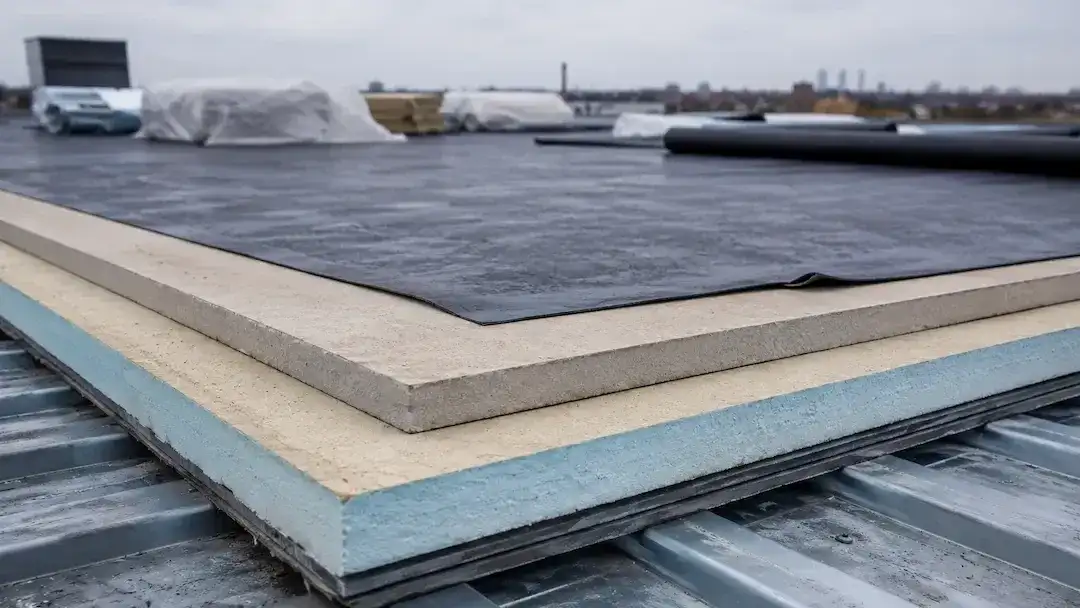
Tapered insulation is where this gets more expensive and more honest. Most older Toronto flat roofs don't drain properly. Ponding water is what kills membranes here, because standing water plus a freeze-thaw winter is a mechanical attack on every seam it touches. A tapered package designed to actually move water to the drains costs more than flat boards, and it's the single upgrade most likely to add years to the roof.
Four questions for every bid: what R-value, what thickness, how many layers with staggered seams, and is any of it tapered.
Line Item #3 — Cover Board
Cover board is the layer between insulation and membrane, and it's the first thing to vanish from a value-engineered quote.
It matters for reasons that are specifically Toronto reasons. It gives the membrane a hard, stable substrate instead of soft foam. It takes the hit from hail and dropped tools. And under snow load and rooftop foot traffic, it stops the insulation below from compressing and dishing — which is exactly how you get the low spots that pond water in the first place.
Gypsum-based boards, high-density polyiso, and asphaltic boards all price and perform differently. "Cover board" on a quote with no product name isn't a spec. It's a placeholder.
Line Item #4 — Membrane (and Why "Same" Membranes Aren't)
Two quotes can both say TPO and be describing meaningfully different products.
Thickness is the obvious one. A 45-mil membrane and an 80-mil membrane are not the same purchase, and the warranty terms available on each are usually different. Then there's the reinforcement scrim, the manufacturer, and the attachment method. Mechanically fastened is cheaper and faster than fully adhered, and it behaves differently under wind uplift on an exposed industrial roof near the lake.
Modified bitumen, the workhorse of commercial roofing here, has the same problem. Two-ply and three-ply systems are both "mod-bit." SBS and APP behave differently in the cold, which is not an academic distinction in a climate that swings from -20°C to +30°C.
If a quote names a system but not the manufacturer, thickness, ply count, and attachment method, you can't compare it to anything.
Line Item #5 — Fasteners, Adhesives & Seam Materials
Small line, real consequences.
Fastener count is engineered, not eyeballed. It's driven by wind uplift calculations for your building's height, exposure, and roof zones — corners and perimeter need denser fastening than the field, because that's where the wind tries to peel the roof off. A contractor pricing a uniform pattern across the whole roof has priced a cheaper roof than the one the engineering calls for.
Adhesives are temperature-sensitive and cost more to apply properly in cold weather. So does the labour. A quote for a February install that prices adhesives the same as a July install is a quote that hasn't thought about February.
Line Item #6 — Flashings & Penetration Details
Roofs almost never fail in the middle. They fail at the edges, and at everything sticking through them.
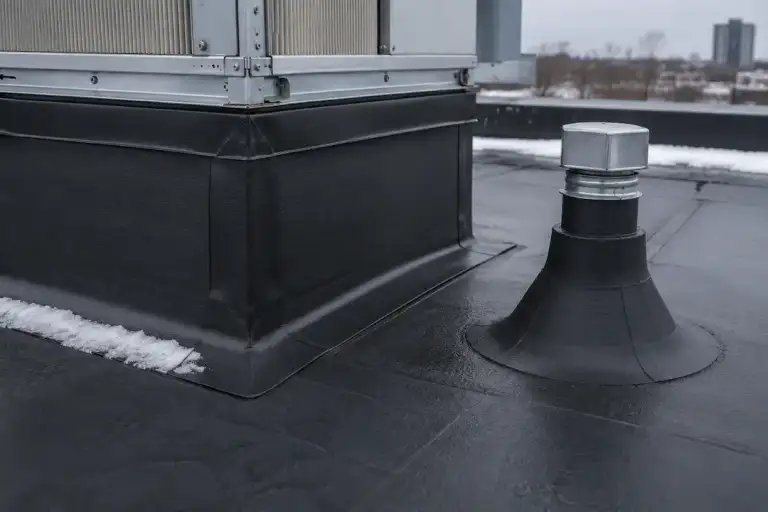
Count what's up there: HVAC curbs, exhaust fans, plumbing stacks, skylights, hatches, drains, expansion joints, parapet walls, equipment rails. Every one is a detail flashed by hand, and every one is a place water gets in when it isn't done right. On a busy industrial roof in Etobicoke carrying a dozen rooftop units, detail work can be a large share of the labour on the entire job.
This is the line item most often buried inside a lump sum. "Flashings as required" is not a scope — it's an invitation to argue later. Ask for penetrations to be counted and priced individually. On our quotes, they are.
Drains deserve their own mention. Retrofitting or replacing roof drains, and adding overflow scuppers where the code requires them, is real money. It's also the work that stops a February thaw from becoming an indoor water feature.
Line Item #7 — Labour, Supervision & WSIB
Labour is the line where quotes diverge the most and disclose the least.
A legitimate commercial crew in the GTA carries costs a low bid may not: WSIB coverage in good standing, general liability at the limits your insurer actually requires, fall-protection training and equipment, and a working supervisor on site rather than a crew lead checking in from another job. Certified crews cost more per hour and put down a roof that passes the manufacturer's final inspection — which is the inspection that issues the warranty you were promised.
Ask for the WSIB clearance certificate and the insurance certificate before you award, not after. If a bidder is slow to produce either one, you've just learned something useful about why their number is low.
Line Item #8 — Crane, Hoist & Site Access
The roof is the easy part. Getting to it is what makes some Toronto buildings expensive.
A downtown site with no laydown area, tight lanes, permit-required lane closures, and material that has to be craned over a building instead of hoisted up the side of it is a genuinely different logistics job than a suburban industrial building with a big yard and clear access.
Then there's the tenant. Occupied buildings mean night and weekend work, noise and odour management, protection of the space below, and coordination with a facility manager who has their own tenants to answer to. Torch-applied work in an occupied building brings hot-work protocols and fire watch. All of it is real cost. All of it is cost a bidder who never visited your site hasn't priced.
Line Item #9 — Engineering & Permits
Not every replacement needs a structural engineer. Some do, and you want to know which before you sign.
If the new assembly is heavier than the old one, if the deck is questionable, if you're adding rooftop equipment, or if the building has any history of deflection, a structural review is the responsible call. Snow load in the GTA isn't a theoretical number, and drifting against parapets and taller adjacent walls concentrates it in ways that surprise people.
Permits, inspections, and OBC documentation carry fees and, more importantly, time. A quote that omits the permit line hasn't made permits free. It's moved them onto your desk.
Line Item #10 — Manufacturer & Workmanship Warranty
There are two warranties on a commercial roof and they cover different failures.
The manufacturer's warranty covers the material. It's issued only if the system is installed exactly to spec by an approved contractor, and it usually requires a manufacturer inspection at completion. Length and coverage scale with the system you actually bought — the thicker membrane and the better assembly buy the longer term. That's why the membrane line and the warranty line are connected: downgrade one and you've quietly downgraded the other.
The workmanship warranty covers the installation. Ours runs up to 15 years and is backed directly by our company, not brokered through a third party. That distinction matters at 6am in year seven when you're calling about a leak and need to know who's actually showing up.
A 20-year warranty from a contractor who's been in business for four years is a marketing document. Ask who's standing behind it, and how long they've been standing.
The 4 Quote-Comparison Mistakes Toronto Property Managers Make
1. Comparing totals instead of assemblies. Two numbers are only comparable if the assemblies underneath them are. Build a simple grid: insulation R-value and thickness, cover board product, membrane type and mil, attachment method, penetration count, warranty terms. Fill it in from each quote. The blanks are the story.
2. Treating the low bid as the same roof at a better price. It's nearly always a different roof. Find the deletion. It's usually insulation, cover board, or detail work.
3. Ignoring cost per year of service life. A cheaper assembly that needs replacing years sooner isn't cheaper. Divide the total by the realistic service life and compare that number instead. Then run it past your capital plan and see which project actually fits.
4. Not asking what's excluded. Exclusions are where the real quote lives. Deck repair, wet insulation replacement, drain work, permits, engineering, disposal of unexpected layers — if these are excluded, they'll become change orders. And change orders are priced without competition.
FAQ
What is the most expensive part of replacing a roof?
Labour is usually the single largest line item on a commercial flat roof replacement. Materials as a group can rival or exceed it depending on the assembly, with insulation typically the most expensive material line — especially where tapered insulation is being installed to correct drainage. On buildings with difficult access, crane and hoisting costs can move ahead of both.
How much does a roll of modified bitumen cost?
A roll of modified bitumen membrane typically covers around 100 square feet and is sold by the roll through commercial distributors. Pricing varies by manufacturer, SBS or APP formulation, cap sheet versus base sheet, and thickness. Material cost alone is a small fraction of installed cost. On a commercial replacement, the membrane rolls usually represent a minority of the total project price, because the substantial costs sit in tear-off, insulation, detail work, and labour.
What is the cheapest way to replace a flat roof?
The cheapest options are usually a single-ply membrane mechanically fastened over the existing roof, or a coating applied to a system still in serviceable condition. Both lower the upfront number and both carry trade-offs. An overlay leaves any wet insulation trapped underneath, makes future leak diagnosis harder, and generally limits warranty coverage. A coating extends a roof's life but does not replace it. The cheapest approach over the life of the building is usually a full tear-off with proper drainage and adequate insulation — because it's the one you don't repeat in ten years.
Get a Quote You Can Actually Compare
Crown publishes every line item on every quote. Compare apples to apples — request a transparent bid for your Toronto or Etobicoke commercial property.
Crown Industrial Roofing
227 Queens Plate Dr, Unit #3, Etobicoke, ON M9W 6Z7
(416) 744-7788 | info@crownroofing.ca
Find us on Google Maps — rated 4.7★ by GTA commercial clients
Serving Toronto, Etobicoke, Mississauga, Brampton, Vaughan, and the wider GTA for over 50 years.
Recent Posts
Book your free roofing inspection
Protect your building with confidence. Our team responds across Toronto and the GTA — and our emergency line runs 24/7.