EPDM Roofing in Toronto: True Cost, Real Disadvantages & When It's the Right Call
EPDM roofing in Toronto costs roughly $6.50–$12/sq ft in 2026. See the real disadvantages, where rubber roofing fits, and when Crown says skip it.
- 2 days ago
The Short Answer — When EPDM Wins in the GTA
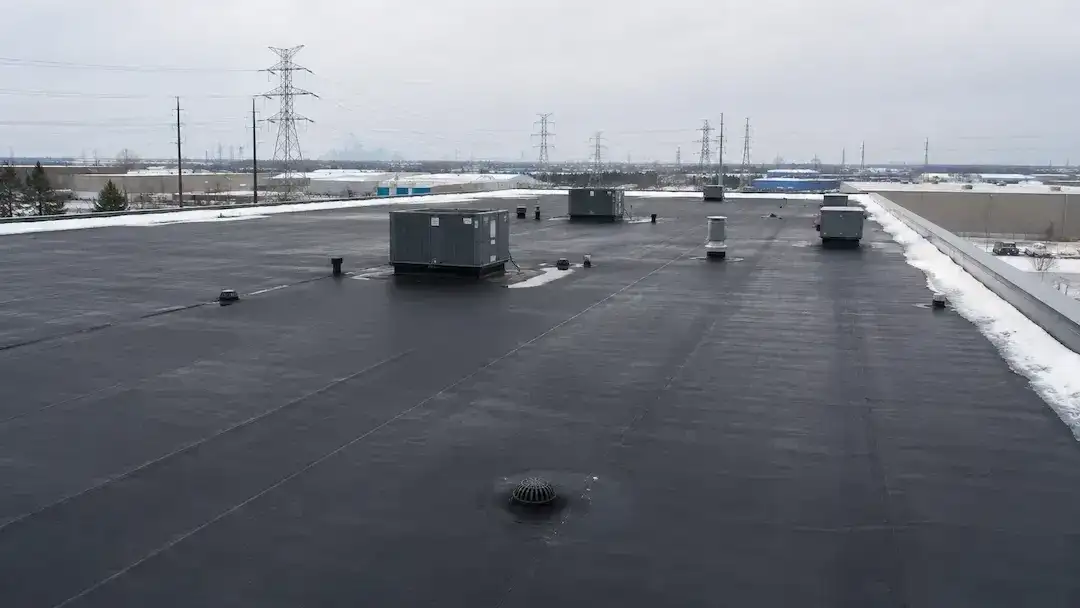
EPDM is the right call when your Toronto building has a large, low-slope roof, a tight capital budget, and a long hold horizon — and when nobody is dragging equipment across the membrane every week. It's a synthetic rubber roof that has been protecting flat commercial buildings since the 1960s, and on the right building it will outlast almost anything else you can put up there.
It's the wrong call when you're trying to cut summer cooling load, when grease or solvents hit the surface, or when the roof gets constant foot traffic. That's the version most sales reps won't give you, because EPDM is easy to sell and easy to install, and "it's the cheapest option" closes deals.
We've been doing commercial and industrial roofing across Toronto and Etobicoke for over 50 years. We install EPDM when it's the right fit and we talk clients out of it when it isn't. Below is the honest breakdown: what it costs in 2026, what it actually does, where it fails, and how to tell whether your building is one of the ones where rubber makes sense.
2026 EPDM Cost in Toronto (Per Square Foot)
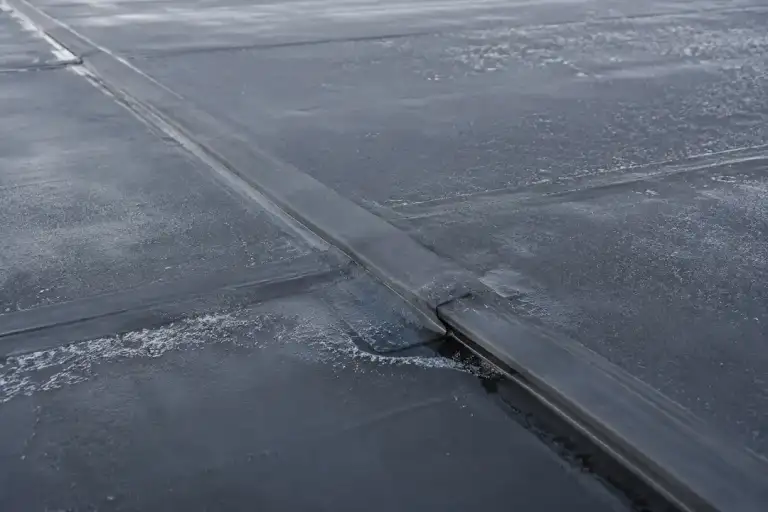
Here's the number most contractors dance around. For a commercial re-roof in the GTA in 2026, installed EPDM generally lands between $6.50 and $12 per square foot. The spread is wide because the membrane is the cheap part — the system is what you pay for.
Roughly where the money goes:
- Ballasted or simple recover (45–60 mil): the low end, around $5–$7/sq ft, when you're going over a sound existing roof and river rock holds the membrane down. Cheapest install, but it needs a structure that can carry the ballast weight.
- Mechanically fastened 60 mil (the common commercial spec): roughly $7–$10/sq ft installed with a cover board and fasteners.
- Fully adhered, thicker membrane (up to 90 mil) with insulation to code: the top of the range, $12–$15+/sq ft, once you factor in polyiso to hit the R-value the Ontario Building Code now expects on a full tear-off.
A few Toronto-specific things push those numbers up. Tearing off multiple old layers adds labour and disposal. A three-storey building downtown or a tight industrial site with no lay-down space means crane and access charges a suburban warehouse never sees. And if the deck underneath is wet or rotted — which we find more often than owners expect — that scope gets added once the old roof is off.
For reference, full commercial flat-roof replacements in Toronto run anywhere from $8 to $20+ per square foot across all membrane types. EPDM sits at the affordable end of that spread. That's its whole appeal, and it's a legitimate one. Just don't mistake "cheapest per square foot today" for "cheapest over 30 years," because those aren't always the same roof.
Any real number for your building comes from a proper, itemized quote after someone has been up on the roof. A figure on a web page is a starting point, not a price.
How EPDM Works (and Why It's the Longest-Proven Flat Roof)
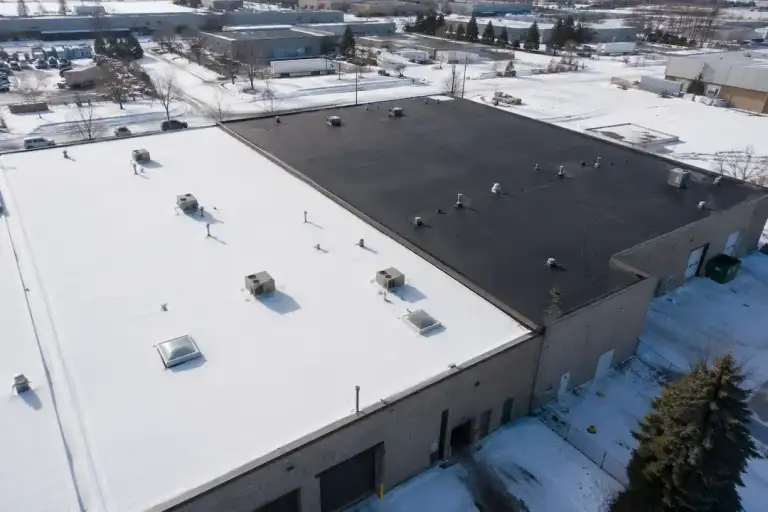
EPDM stands for ethylene propylene diene monomer, which is a chemist's way of saying synthetic rubber. It's a single-ply membrane: one layer of rubber laid over insulation and a cover board, rather than the multiple built-up layers of an old tar-and-gravel or modified bitumen roof.
Two things make it distinctive. First, it ships in enormous sheets — up to 50 feet wide — so a large roof can be covered with very few seams. Fewer seams means fewer places for water to find a way in. Second, it stays flexible when it's cold. That matters a lot in a climate that swings from –20 °C in January to +30 °C in July and cycles through freeze-thaw dozens of times a winter. Rubber flexes with that movement instead of cracking.
It gets held down one of three ways: loose-laid and weighted with ballast, mechanically fastened with plates and screws, or fully adhered with glue. Each has cost and performance trade-offs we'll get into.
The track record is the real headline. Some EPDM roofs installed in the 1970s are still keeping water out in 2026. No other single-ply membrane can point to that kind of half-century field history, because none of the others have been around that long. When you're committing serious capital to a roof, "we've watched this material work for 50 years" is not a small thing.
EPDM Pros for Toronto Buildings
The case for EPDM in the GTA is mostly about cold and cost.
It handles our winters. EPDM stays pliable at temperatures where some newer membranes get stiff and brittle. Freeze-thaw cycling, ice, expansion and contraction — the rubber moves with all of it. For a Toronto or Etobicoke building, cold-weather performance isn't a nice-to-have, it's the whole ballgame.
It's genuinely long-lived. A properly installed EPDM roof runs 25 to 40 years, and well-maintained thicker systems push past that. On a low-slope roof that isn't getting abused, it's about as close to "install it and forget it" as flat roofing gets.
It's affordable up front. Lower material cost and straightforward installation make it the budget-friendly single-ply option. If capital is tight and the building fundamentals fit, that saving is real.
Repairs are simple and cheap. A puncture or a lifted seam is usually a patch job, not a callout that turns into a quote for a new roof. Any competent commercial crew can service EPDM without specialized welding equipment.
Those are real strengths, and on the right building they add up to a roof that quietly does its job for decades. But every one of them comes with a catch, which is the part that gets left out of the sales pitch.
The Real Disadvantages of EPDM (the Sales Reps Won't Mention)
Puncture vulnerability
EPDM is rubber, and rubber can be punctured. Dropped tools, a technician's ladder, a dragged pallet, hail, a satellite installer who doesn't respect the surface — any of it can put a hole in the membrane. Thicker membrane (60 or 90 mil) resists this better than thin 45 mil, but no rubber roof loves foot traffic. If your roof gets walked regularly for HVAC or equipment service, you need walk pads designed in from day one, and even then you're managing a known weak point.
Seam dependency
The membrane itself rarely fails. The seams do. EPDM sheets are joined with seam tape and adhesive, and while the big sheets mean fewer seams to begin with, the ones you have are the roof's most likely failure point over time. Tape adhesion is what ages, not the rubber. This is exactly why installation quality matters more on EPDM than on almost any other system — a perfect membrane with badly rolled seams is a leak waiting for the right rainstorm.
Heat absorption with black membrane
Standard EPDM is black. Carbon black is what stabilizes it against UV, but it also means the roof absorbs heat like a parking lot in July. On a Toronto summer day that surface can run brutally hot, which drives up cooling costs for the space underneath and adds thermal stress to the whole assembly. In a city that already fights an urban heat-island problem, a black roof is working against your HVAC bill every sunny afternoon.
Aesthetic limitations
This one's simple: EPDM looks like a black rubber sheet, because that's what it is. On a low-slope roof nobody sees, who cares. But if the roof is visible from a taller neighbouring building, an office tower, or a mixed-use development where appearance is part of the property's positioning, EPDM is not going to win any beauty contests. It's a functional surface, not a design feature.
Adhesive vs mechanical attachment trade-offs
How you attach the membrane changes the roof's behaviour, and there's no free option. Ballasted is cheapest but loads your structure with rock and can hide problems underneath the stone. Mechanically fastened is the common middle ground, but every fastener is a penetration and the plates can telegraph or back out over time. Fully adhered gives the cleanest, most wind-resistant result and costs the most, and it depends entirely on the glue being applied right in the right conditions. Pick the wrong method for your building and you've either overspent or bought a roof that underperforms in wind.
None of these are dealbreakers on their own. Together, they tell you EPDM is a specialist's tool — excellent for a specific job, wrong for several others.
Toronto Building Types Where EPDM Is the Right Call
EPDM shines on large, simple, low-traffic roofs where budget and longevity matter more than reflectivity or looks:
- Warehouses and distribution centres with big, uncomplicated roof planes and few penetrations. The huge sheets cover ground fast with minimal seams, and the roof isn't being walked daily.
- Industrial buildings in Etobicoke, Rexdale, and across the GTA where the roof is out of sight and the priority is a durable, cost-effective envelope that survives decades of freeze-thaw.
- Cold-storage and unconditioned spaces, where heat absorption is a non-issue and the rubber's cold flexibility is a genuine asset.
- Long-hold institutional properties — the owner who plans to keep the building for 30 years and values a proven lifespan over a lower cooling bill.
If that's your building, EPDM isn't a compromise. It's arguably the smart pick, and it's the kind of scoping call we walk owners through during an on-site assessment of the whole roof before we recommend any system.
Toronto Building Types Where EPDM Is the Wrong Call
Just as important — where we'll tell you to skip it:
- Restaurants, commercial kitchens, and food-processing sites. Grease exhaust and solvents chemically break rubber down. This isn't a maintenance issue, it's a chemistry mismatch. For grease and chemical exposure you want a heat-welded single-ply system built to resist it, not EPDM.
- Buildings chasing energy savings. If cutting summer cooling load is the goal, a black rubber roof is the wrong surface. A reflective membrane will do more for your HVAC bill.
- High-traffic roofs. Constant service access, rooftop patios, heavy equipment maintenance — anywhere people and gear move across the surface regularly, the puncture risk stops being theoretical.
- Visible roofs where appearance matters. If tenants, buyers, or neighbours look down on it, the aesthetics work against you.
The honest read: EPDM is a great roof on maybe half the buildings it gets sold for. The trick is knowing which half you're in before you sign.
White EPDM vs Black EPDM in the GTA
You can get EPDM in white, and it's worth understanding the trade. White (or white-coated) membrane reflects sunlight instead of absorbing it, which can cut cooling costs meaningfully compared with black — the reflectivity difference is large on a hot roof. In a Toronto summer, that's a real operating saving on an air-conditioned building.
The catches: white EPDM costs more up front, it shows dirt and needs cleaning to keep reflecting, and the coating can weather over time. Black EPDM is cheaper, hides grime, and is the default for a reason. So the decision is straightforward. Conditioned space where you're paying to cool the building? White usually earns its premium. Unconditioned warehouse or cold storage? Black, and don't overthink it.
If reflectivity is the driving factor, though, it's worth asking whether a purpose-built reflective membrane beats white EPDM for your situation. That's a real comparison, not a foregone conclusion, and it's one we'll run honestly rather than steer you toward whatever's easiest to install.
How to Vet an EPDM Installer in Toronto
With EPDM, the installer matters more than the material, because the failure points are all workmanship. A few things worth asking before you sign:
- How do they handle seams? Seams are where EPDM fails. You want to hear specifics about primer, tape, and rolling — not a shrug.
- Which attachment method are they recommending, and why? If they can't explain why ballasted vs. mechanically fastened vs. fully adhered is right for your structure and wind exposure, they're installing what's convenient for them.
- Do they tear off and inspect the deck, or just cover the old roof? A cheap recover over a wet deck is a future disaster wearing a warranty.
- Are the crews theirs, or subcontracted? Subbed-out labour is where quality control goes to die on seam work.
- What does the warranty actually cover — material, workmanship, or both — and in writing? A manufacturer material warranty means nothing if the labour that voids it isn't covered too.
A contractor who answers these plainly is one worth quoting. One who gets vague is telling you something.
The Bottom Line
EPDM is the longest-proven flat roof there is, it handles Toronto winters better than most, and it's affordable up front. It's also puncture-prone, seam-dependent, heat-absorbing in black, and flat-out wrong for grease-exposed, high-traffic, or cooling-sensitive buildings. Both of those things are true at once, and any contractor who only tells you the first half is selling, not advising.
EPDM is the right call on the right building. Crown will tell you honestly whether your Toronto property is the right fit.
FAQ
How much should an EPDM roof cost?
For a commercial building in Toronto in 2026, installed EPDM typically runs about $6.50 to $12 per square foot. A simple recover or ballasted system sits at the low end (roughly $5–$7/sq ft), while a fully adhered, thicker membrane with insulation to code can reach $12–$15+/sq ft. Tear-off of old layers, deck repairs, and crane or access requirements on tight or multi-storey sites all push the number higher. The only accurate figure comes from an itemized quote after a roof inspection.
What are the disadvantages of EPDM roofing?
EPDM's main disadvantages are puncture vulnerability (it's rubber, so dropped tools, foot traffic, and hail can pierce it), seam dependency (the taped seams are the most likely long-term failure point, not the membrane), heat absorption from the standard black surface (which raises summer cooling costs), limited aesthetics (it looks like a black rubber sheet), and attachment trade-offs (ballasted, mechanically fastened, and fully adhered each carry cost or performance compromises). It's also a poor fit for grease-exposed or high-traffic roofs.
How much does EPDM roofing cost in Canada?
Across Canada in 2026, EPDM roofing generally costs $4 to $14 per square foot installed, with $6 to $12 the typical range. In Ontario specifically, flat-roof EPDM and TPO systems usually land around $6.50 to $11 per square foot, and commercial-grade systems with added insulation and manufacturer warranties can reach $12 to $18 per square foot. Membrane thickness, attachment method, insulation level, tear-off, and building access are the main factors that move the price.
Is EPDM better than shingles?
For a commercial or industrial building, this isn't really the right comparison — asphalt shingles are a sloped-roof residential product and aren't used on the low-slope flat roofs EPDM is built for. If your building has a flat or low-slope roof, EPDM (or another commercial membrane like PVC, TPO, or modified bitumen) is the appropriate category, not shingles. The real decision for a Toronto commercial owner is which flat-roof membrane fits the building, not membrane vs. shingles.
Crown Industrial Roofing
Book your free roofing inspection
Protect your building with confidence. Our team responds across Toronto and the GTA — and our emergency line runs 24/7.